

Be Everywhere. Know Everything.
- Jun 15
- 3 min read
Updated: 6 days ago

Every company has an information highway.
Everything involved in moving a product or service from its earliest stages into the hands of a customer develops a complex maze of data and information beneath it all. Every interaction with the process contributes to a constantly evolving picture of how a business operates. Information forms a dynamic chain flowing between people, systems, suppliers, customers, machines, and processes, and every action influences the state of everything connected to it. Some of this information is structured and easily captured. Much of it is not. It can exist in databases, reports, spreadsheets and software, but also in conversations with colleagues, feedback from customers, and observations from the factory floor. Together, these layers form a complete picture of how a company truly functions, yet only a fraction of that picture is ever visible and it's always changing.
Companies exist within markets where customer expectations and needs evolve, supply chains shift, technologies advance, attracting skilled and driven employees becomes harder, competitors adapt, and the changing economic environment shakes the very foundation these businesses are built on. People find themselves on a grand ever-moving staircase where standing still is often the same as falling behind. The ability to understand what is happening inside a company and adapt to what is happening outside of it has become one of the defining advantages of modern business. Every function within a business produces many layers of information, insights and context.
The problem is that most of this picture never makes it to the surface, and even if it did we wouldn't have the tools to make sense of it.

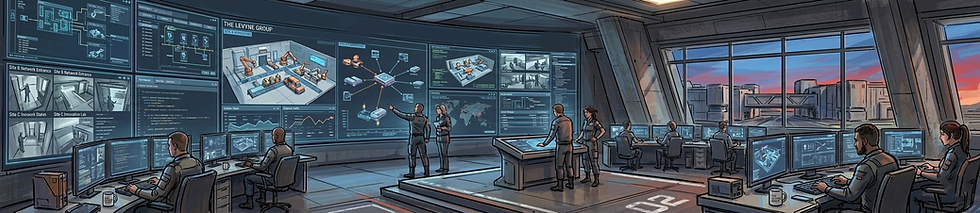

Our systems structure the information highway inside Manufacturing businesses to generate an accurate picture of the enterprise in real-time and close the gap between where a company is and where it could be at it’s best.
For decades, businesses have adopted software to solve problems. Accounting systems for finance. CRM platforms for sales. ERP systems for operational control. Quality systems for compliance. Each solved a specific challenge and delivered measurable improvements and some in more areas than one. Yet every new system also created another island of information, and another boundary around data.
Over time, these islands became whole continents and connecting the information across them to make sense and use of it, became impossible. Critical knowledge became trapped inside departments, hidden inside processes, or locked inside the minds of experienced operators who learned how to navigate complexity through experience. As this happened, businesses slowly began building themselves within the limitations of their software and adapting themselves to the restrictions of their operating model. The result is a generation of companies that are better than they once were, but still far below what they could become if they could access and use the full scope of information flowing beneath them.
Every person within a company sees a different part of the puzzle, Technicians, engineers, managers, business owners, administrators, and salespeople all operating from different perspectives, yet they are contributing to the same system. When people are given the tools to become better at what they do and complexity is held beneath the surface where it belongs, then software once again becomes a tool for growth and not a pair of inescapable handcuffs.
For most companies, the information required to become faster, more efficient, more resilient, and more competitive already exists. The challenge has been seeing it, connecting it, understanding it, and using it. The companies that solve this gain the fundamental advantage. They can react to problems sooner, they adapt to changing markets faster, and they make better decisions because they have access to a more complete picture of reality, every step of the way.
You can be anywhere and know everything.


